


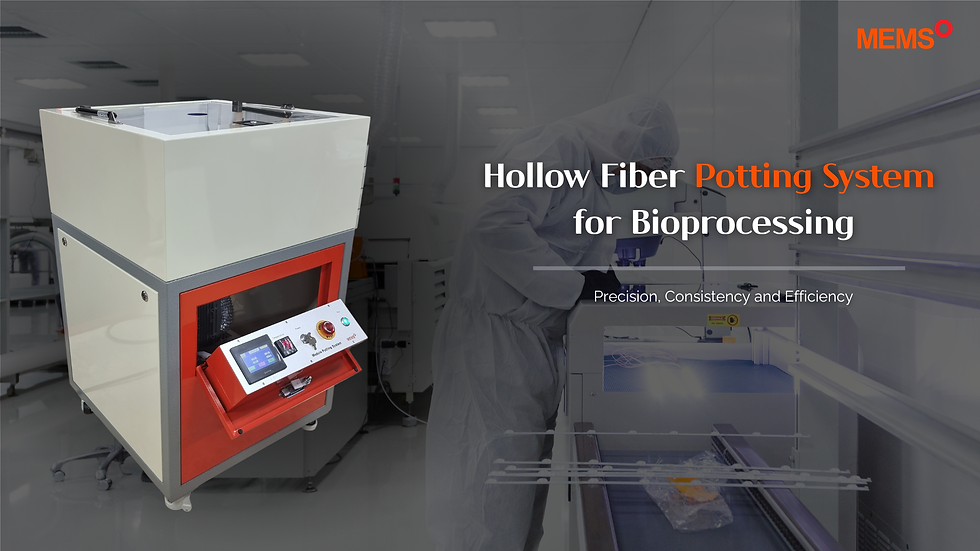
Hollow Fiber Potting System for Bioprocessing: Precision, Consistency and Efficiency
- denis7884
- Nov 7, 2025
- 2 min read
Updated: Nov 20, 2025
The Growing Demand for Accuracy in Bioprocessing Research
Biologics now account for over 70 percent of global pharmaceutical revenue among the top-selling drugs. This dominance drives demand for bioprocessing tools with precision and scalable performance. To meet this need, research and development (R&D) labs must cultivate cells, isolate proteins and purify products in tightly controlled environments to produce reliable data.
Bioprocessing processes require control over which molecules move and which remain. Membrane technology performs this function by acting as a selective filter. Among the different types, hollow fiber membranes provide high surface area and efficient separation, making them widely used in bioprocessing workflows. Each fiber is a thin, flexible tube with an inner diameter often between 200 and 500 micrometers. Thousands of filaments form a bundle, which provides a large surface area for fluid flow and separation. This structural design makes hollow fiber membranes particularly useful for applications such as cell retention in perfusion cultures, protein purification and ultrafiltration.
To optimize performance, hollow fibers are most effective when assembled into well-designed modules that hold them uniformly and ensure even liquid distribution. This arrangement allows researchers to replicate production-scale conditions on the bench, monitor cell growth, refine protein recovery and maintain consistent performance despite changes in process variables.
Key Challenges in Hollow Fiber Module Fabrication
However, even with careful design, R&D labs face practical challenges when building these modules. Within this context, three persistent obstacles dominate:
Fiber Alignment: Misalignment disrupts flow paths and lowers separation efficiency.
Sealing Accuracy: Uneven sealing leads to leaks and inconsistent flow.
Material Compatibility: Inadequate potting materials can react with samples or weaken module integrity.

These challenges have practical consequences. They delay experiments, waste costly media and reduce confidence in scale-up predictions. Addressing them requires automated process control, validated materials and repeatable manufacturing steps.
MEMS Solutions for Bioprocess Research
MEMS hollow fiber potting systems respond to these needs by incorporating design features that improve reproducibility and simplify operation. For instance:
Automated Regulation: HMI interface for programming potting parameters, curing time and pressure or vacuum settings
Material Versatility: Supports various potting materials, including epoxy and polyurethane, for different biomanufacturing requirements
Precision Curing: Controls temperature and pressure to ensure strong, leak-free seals
User-Friendly Operation: Simplified setup procedures promote consistency between runs
In practice, the following images illustrate the step-by-step process of unit installation and operation.

Advancing Bioprocessing Through Precision Tools
Ultimately, this reinforces the importance of dependable systems in minimizing risk and maximizing efficiency as processes scale. Hollow fiber potting systems offer the precise control and operational reliability essential for advancing cell culture, perfusion and filtration studies. As a result, R&D labs gain confidence that processes developed at small scale will seamlessly scale to commercial production, with consistent performance and reproducible outcomes.
Ready to Address R&D Bioprocessing Challenges?
For inquiries about implementing hollow fiber systems in your laboratory, contact MEMS at:
Email: info@wellspring.co.kr Website: www.pmems.co.kr for more details.

Comments